Book: Manhunter: The Special Edition
Pen: Archie Goodwin
Pencil: Walt Simonson
Sometimes, magic just happens. Because of, irrespective of, in spite of circumstances, magic happens. In comics it is very hard to come across such examples, even more so when the name Alan Moore is not connected with it. Manhunter: The Special Edition is magical.
Manhunter was a pretty obscure character that existed from the 1940s. He had many avatars and was always on the second rung, despite having a run by the one and only Jack Kirby. He still is. But in 1973, Archie Goodwin and Walt Simonson joined together for a brief journey. A magical journey.
Paul Kirk, aka Manhunter from the ‘40s, suddenly shows up in Nepal. Nothing so unusual but for the fact that he had been dead for decades. Everything points to an imposter, but his fingerprints are the same and he looks exactly like how he looked 30 years before. Christine St Clair, an Interpol agent, is after him. She finds him and unravels a conspiracy that is way bigger than anything she had ever imagined. Involving the greatest minds of the world from the 1940s, a search for a peaceful world, the corruptibility of the human mind and the determination of one man to make a difference, the story unravels across countries with a breathless pace. It culminates in a shattering climax.
Manhunter came out in an eight-page format. It was an additional story in the main Detective Comics issue which featured Batman and other higher-rated heroes; an extra. This Manhunter ran for seven issues, out of which six were only eight pages long! Eight pages to make an impact each time. And twice for these eight pages they won awards for best story. Goes to show size doesn’t matter for magic! For the last issue, they decided to include Batman in the storyline and suddenly they were the main event.
The eight-page format meant you had to find a fine balance between story and visuals that would prevent either from overcrowding the other. Enough things should happen to give a structure to the story, but not so much that it seemed like cramming. The initial storyline – The Himalayan Incident – is startling in its economy, but extremely effective in introducing the character. Cathedral Perilous, my personal favourite, has a fabulous set up. A tourist family turns up at an old cathedral. They walk around taking photographs, while the youngest son is the one witnessing incredible things happening. Of course he is not even able to tell that to his parents. And when he ends up saving someone, he realizes the dream of every comic fan of playing a part in their favourite comic.
The story of Manhunter is not extraordinary. It does not introduce any ground-breaking theory or have a humdinger of a plot with unexpected twists aplenty. It also does not introduce any new style of drawing. But what it does is takes itself and its reader seriously, while accepting it is about a comic book character. In very few pages it manages to tell a complete story that is large in its scope, intimate in its characterization and flawless in its construction. You cannot wait to turn the page, but also do not want to rush yourself.
The Special Edition has an added story that is amazing in that it never feels like an add-on. For the 25th Anniversary edition the collaborators were asked to write another short story. While initially skeptical, they both arrived at how they would approach it. In between Archie Goodwin died. Walt Simonson made it the ultimate tribute to his friend by making it a silent comic, without any dialogue. What could have been a tacky and commercial venture instead became a poignant and poetic epilogue to a fully-realised epic. In short, it remained magic.
Book: Green Arrow: The Longbow Hunters
Pen: Mike Grell
Pencil: Mike Grell
Green Arrow can easily, and to an extent, correctly, be described as the poor man’s Batman. Billionaire, playboy, vigilante without superpowers, young kid’s guardian, who later became a sidekick, the whole shebang. It all changed when the billionaire became a leftist. Suddenly he became more interesting. A seemingly ridiculous combination with Green Lantern seems to have been a huge success with the writers being able to tackle real world concerns within the framework of comics.
The real, gritty re-imagining happened with this book. Mike Grell was asked to write and draw a three-issue storyline. Grell did that, and stayed on. He decided that the flashiness and the trick arrows of old had to go. He didn’t try to get rid of the Robin Hood inspiration, but instead just let Arrow be an admirer of Robin Hood. The action was shifted from the fictional Star City to Seattle, where Oliver Queen aka Green Arrow has moved to with his girlfriend Dinah Lance, who also moonlighted as the crime-fighter Black Canary.
In Seattle, two sets of serial killings were making headlines. Prostitutes were being slashed by someone with a very sharp knife, and senior citizens were being bumped off by someone with very sharp arrows. Meanwhile, a cracked-up junkie lands on their porch.
Dinah decided to go and find the source of the drugs, while Oliver decided to work on relaxing the fingers by going after the local hoods. He soon finds who the slasher is, but comes out badly in the encounter. The next girl is about to be killed and Oliver is late on the scene. But then a mysterious arrow kills the man. The archer turns out to be a masked female. Before introductions are made, she turns around and shoots another geriatric.
The Longbow Hunters is a major milestone in Green Arrow’s journey. Yet you feel it should have been much more. It touches all the right chords, keeps itself rooted in reality, connects to the then-recent political events and has a good structure. But somehow it seems to be missing something. Maybe the story should have been a little longer. You need to read it two or three times to get a hang of what happened. While this is not necessarily a bad thing, here it feels abrupt. The artwork is efficient, without being overly pretty, but then this is not a pretty story.
The writing, unfortunately, does not rise above the average. The Green Arrow is famous for having a at least four quips for every situation. Here there is nothing that stands out. The same person performing both writing and drawing duties meant there wouldn't be any conflict of visions. At the same time, a different collaborator might have brought something different to the table. The Longbow Hunters seem like a project that had so much promise, but delivered less. Maybe I am wrong. The Longbow Hunters might have been a milestone comic that was ahead of its time. It just hasn't aged well.
Book: Wolverine
Pen: Chris Claremont
Pencil: Frank Miller
I’m Wolverine. I’m the best there is at what I do. But what I do best isn’t very nice.
Of course you have read it before. Even heard it in the movies. But imagine you haven’t. You can imagine. You are a comic book lover, after all. Imagine opening a comic book about a second-rung character who never had a solo series. These are the first lines in the book. Suddenly you get a chill. Am I about to read something spectacular? Is this the kind of book every comic lover dearly loves to discover? A bolt from the blue. A masterpiece without an advance warning. An hour later you put it down. The naked awe on your face says it all.
Wolverine was a popular side character. His propensity to use extreme force at the slightest provocation (or not) was his biggest draw. He was a pint-sized bunch of dynamite, probably as tall as Hugh Jackman’s third rib. After all, the animal he was based on was very small and very dangerous. But this violent streak also made him a pretty one-dimensional character. Not too many writers found him that interesting beyond a point.
It was under such circumstances when comic legend Chris Claremont joined hands with a young artist called Frank Miller to bring out a four-issue miniseries. Yes, that Frank Miller. And no, I didn’t get the names interchanged. Before attaining superhero status himself and rising to (IMHO) the second position on the list of great comic writers, Miller made a name as an artist.
Claremont and Miller did the unthinkable. They took the action to Japan. To take a hot-blooded American superhero to space was fine, but outside the US, only sporadic visits were allowed. Technically, Wolverine is Canadian, but you know how so many Americans think it is the 51st state! But to have a complete story set in another country was just not done. But the co-conspirators had no choice. They were going to treat Wolverine as a ronin, a fallen samurai. And Japan had to be the scene.
Beginning with a primeval encounter with a man-eating bear in the mountains, Wolverine travels to Japan to be with his beloved Mariko Yashida who had run away without an explanation. There he finds that Mariko was forced by her father to marry another man. Wolverine was bested in a duel by Shingen, Yashida’s father, and left for dead. He is saved by Yukio, a mysterious girl highy skilled in the art of warfare. Wolverine and Yukio join hands to escape the group of assassins known as the Hand. Together they find ways to save Mariko from her fate.
Wolverine is an adventure story. It is also a love story. Taking the familiar trappings of a man in search of his woman, Claremont and Miller transport it to another land and culture. With minimum fuss they tell a story and they are done with it. But they do it with such precision that you are not left wondering if anyone could have done it better. You know no one could have.
Claremont would go on to become one of the most prolific writers of Wolverine, but these four issues are probably the best he has conjured up. Miller is prodigiously, no, ridiculously talented. I usually leave discussions on artworks to the experts, but one thing that is stunning about this book is how well it holds up against the ravages of time. You do not feel that it is from a period where most of the artwork today seems silly and dated. There is a sense of motion in each page and the action is choreographed in the truest sense of the word.
The graphic novel should have stopped at four issues. Instead it adds an additional two issues from The Uncanny X-Men to it. This is a continuation of the story with a different artist, but ends on a cliff-hanger. It may work as an extra, but to club it with the Wolverine miniseries is to dilute its effect. But that’s me nitpicking. Wolverine is a game-changer. This is one of those stories that will stand the test of time. A perfect alchemy of a great writer and an amazing artist.
Title: The Ultimates 2 – Vol 2: Grand Theft America
Pen: Mark Millar
Pencil: Bryan Hitch
Hawkeye!
If you want to take out one defining image from Grand Theft America, then it is Hawkeye. A minor character who is always almost a sidekick to the gods and monsters and superhumans in the Ultimates, an interrogation scene in this book shows us Hawkeye like we have never seen him before. He is a human without any steroid-enhancements or explosion-exposures. Just a dude with a particular set of skills. And what skills! If you henceforth cringe at any comic or movie where Hawkeye is part of the scenery, then this book is responsible.
Let’s go back to the beginning. The Middle-Eastern interference in Gods and Monsters caused a lot of after effects. One of it was a young boy who hated Captain America for what he considered an unprovoked attack on him and his country. The boy would become the trump card in Loki’s grand scheme.
Hawkeye’s family gets attacked and there are no remains of anyone. SHIELD checks the secret cameras and discovers, to their horror, who the traitor is. The shattered team has no time to regroup when Loki makes his move. This is the stuff of their worst nightmares and America is going down. With five of their original team either incarcerated, or disgraced or a traitor, Quicksilver and the Scarlet Witch have a lot to do, especially during the battles. But the battle is never truly over unless it is over.
Millar’s liberal politics play a big part in the plot. And it is actually kind of reassuring to see America pay for their foreign policy decisions! In the end, however, this is an American mainstream comic that would be read mainly by Americans, so the fault cannot be theirs alone. Still, one has to admire the guts and gumption Millar, during his peak, brought to what should have been all-out superhero story.
Bryan Hitch’s art is top-notch throughout. It is very evident why he is such a sought-after artist. The writer and artist tango like rarely done before to create a high quality product that will ensure the one thing you do after completing the book is to start again. Be glad you live in a time when Millar and Hitch’s Ultimates run is over. It means you have the opportunity to read the whole story at one go. I honestly cannot think of waiting months for the next issue.
Grand Theft America is a fabulous climax to The Ultimates saga. It is the single biggest reason to acknowledge that the Ultimate line that Marvel created was not just a gimmick. This is what superhero comics should aspire to. Oftentimes, in the midst of all the pontification and pondering and psychoanalysis, the casualty is fun. Millar and Hitch’s run on The Ultimates never lets that happen.
At the end, though, Grand Theft America still can be encapsulated in one word.
Hawkeye!
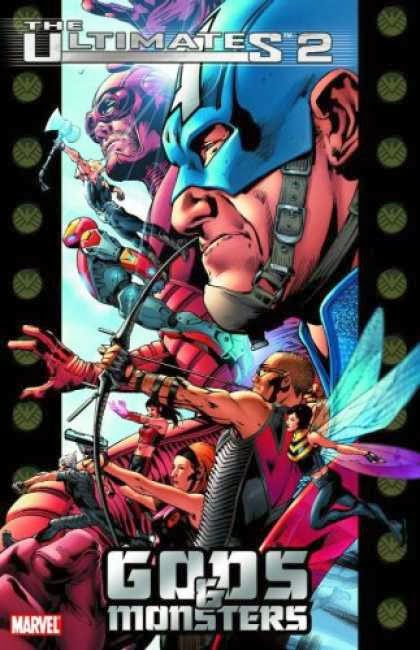
Book: The Ultimates 2 – Vol 1: Gods and Monsters
Pen: Mark Millar
Pencil: Bryan Hitch
The Mighty Thor has his day, and more, in Gods and Monsters. All over The Ultimates, Millar has been teasing us how not everyone was buying the whole ‘Thor is a god from Asgard’ line and people still believed he was just a crackpot with his heart in the right place. It is time to settle that.
The American government, as it usually did, decided to interfere in the affairs of a Middle Eastern country. The supposedly global peace-keeping force – the Ultimates – were sent to sort it out. They did. But Thor dissented and pulled out of the team-up. Before you could say “Ultimates Disassemble” the secret about Hulk is leaked out. The public screams for blood and Fury is only too eager to give them a scapegoat. Despite a blind lawyer, one Matt Murdock, defending him, the jury already made up their minds and it is time for one of the most shattering decisions in comics.
While SHIELD was trying to move into damage control mode they received a call from the European Defense Initiative, the guys who created Captains Britain, France, Spain and Italy! They also meet Gunnar Golmen who was heading the Norwegian group and the secret of Thor comes out. It is time to take the so-called God of Thunder down.
On another note, after his loss of face, Hank Pym is not allowed anywhere near the Ultimates. He goes and joins another superhero team up called the Defenders, which doesn’t exactly end well. But then he learns the truth that is going to be the pivot of the Ultimates 2 storyline. There is a traitor in the ranks.
If you are going to have Thor in the limelight, then you should have his main adversary, too. Loki makes his entrance briefly, but you know he has big plans. Gods and Monsters sets up everything for a grand finale, but that is not to say that it is not capable of standing on its own. With, not one, but two catastrophic events, this is an action-packed edition leaving hardly any time to breathe. At the same time, the constant cut to how the world reacts is how Millar grounds his comic.
The four editions of The Ultimates and The Ultimates 2 can be compared to a relay. Gods and Monsters is the under-appreciated third-leg. As any coach would tell you if your third man is not solid, you would be leaving the impossible for the anchor. Gods and Monsters is solid. The Ultimates are shown at their most vulnerable. An opponent smart enough can dismantle them brutally. And they have such an opponent. Doubts are slowly being raised about the position the Ultimates hold, who they report to and when they should stop. We know a storm is coming. And we can’t wait.
Book: The Ultimates – Vol 2: Homeland Security
Pen: Mark Millar
Pencil: Bryan Hitch
The origin story is over. We had intros, adjustment issues, management lessons on teamwork, a threat to a big city, an almost happy ending and an unexpected cliffhanger. Now comes the part where we wrap up Season 1. If the first volume of The Ultimates gave an idea which book vaguely inspired The Avengers movie, then The Ultimates Vol 1 – Homeland Security will almost have you calling Joss Whedon a plagiarist! Relax, folks, it’s all in the family!
Super-Human ended with a freak attack, the true story of which never reached the common man. As a result, the Ultimates suddenly became heroes. While New York was grieving for its dead, the Ultimates suddenly had to deal with a rogue element within the team. As I said before, The Ultimates showed Captain America in a new, exciting light. In this volume he has a bigger role and you see how a man who believes in simple things like right and wrong goes about his business. The values he stood for should seem silly and out-of-place in these times. Yet you root for him. It doesn’t hurt that Millar saves some of the best one-liners he has ever written for Captain America.
The second volume brings to the fore two major characters – Hawkeye and Black Widow – and introduces two minor, seemingly useless members – Quicksilver and Scarlet Witch – to the team. In the first mission starring Hawkeye aka Clint Barton and Widow aka Natasha Romanoff, we are introduced to the major villains – the Chitauri. Since we have established that the Ultimates are pretty out-of-this-world, it is only natural that the villains are aliens. Their agenda cupboard may be pretty threadbare, but it certainly needs all the Ultimates to band together to stop them.
The most striking thing about Homeland Security is the way action sequences are captured. Rarely has action seemed so fluid. It is almost like the pictures are moving. I don’t mean there are many panels of the same scene with minute differences. But it is evident that a lot of thought went into these. Millar, as he always does, wisely lets the artist come up front and centre during the violence and mayhem.
A horny Hulk is both hilarious and scary. That was one of the revelations of the first volume and it continues here. Hulk’s personality may suffer a bit here as he is not shown as anything but a big, stupid brute who comes across as being unintentionally funny. But there is lot of sympathy for Banner. Iron Man in the comics is definitely not as prominent as Robert Downey Jr in Avengers. But he does have his moments. Thor continues to be a bit of mystery with his eco-warrior avatar while being an ex-nurse who had spent time in a lunatic asylum. This would have been a good sub-plot were it not for the fact that Thor has publically saved a lot of people, so the fact that he has a lot of powers should not be a matter of question at all.
Homeland Security may not have the deafening impact of Super-Human. But it is a very solid conclusion to the Ultimates saga. We are left with a Samuel L Jacksonesque smirk feeling very satisfied with the read. That is something we cannot say about a lot of comics. I heartily recommend both volumes of The Ultimates. Just don’t expect me to lend them to you!
Book: The Ultimates – Vol 1: Super-Human
Pen: Mark Millar
Pencil: Bryan Hitch
At the turn of the millennium Marvel comics was coming out of a tough phase where it had filed for bankruptcy. They made a decision to ‘go Hollywood’ with their main titles. The term didn’t stand for adapting their comics into movies, but changing the comics in a way that they appealed directly to most of new generation, not just the few that read comics. Like Hollywood, they decided the only people that mattered were the 18-to-25-years age-set and the comics were to reflect that.
Enter the Ultimate Marvel imprint. By basing their comics in another one of the infinite alternate universes in the Marvel Multiverse.(Essentially, a lazy excuse to churn out stories that did not fit into the continuity of the characters.A devise like ‘warp speed’ in sci fi!) All the major characters – Spider-man, X-Men, Fantastic Four – underwent the Ultimate treatment, which meant that almost all the characters became of high school age! When it came to the Avengers they realized they couldn’t just reduce the ages. A more thorough re-imagining was necessary. Mark Millar and Bryan Hitch were the people in charge and they were also asked to rename the Avengers as the Ultimates.
Nick Fury, the eye-patch-wearing boss of SHIELD, decided to get a team of highly capable individuals together in order to deal with threats that could not be handled by the military alone. He gets Dr Bruce Banner, who was holed up in a dingy research facility trying to recreate the super soldier serum that was responsible for turning puny Steve Rogers into Captain America almost 60 years ago. Also joining were Dr Hank Pym, who was researching how he could change size into a 60-feet giant, called Giant-Man, and also how he could control ants.His wife Jan, aka the Wasp, could size-shift into the size of a wasp. (Don’t you like it when the superhero names are accurate to the point!)
Fury was thrilled, but suspicious, when billionaire inventor Tony Stark decided to join in along with his entire Iron Man tech. He also tried to recruit a charismatic hippie eco-messiah called Thor who was leading a bunch of activists against consumerism and capitalism. Thor was widely known to be an ex-nurse who had spent time in a lunatic asylum. But he was also known to possess some powers. Unfortunately, Thor had no intention in joining up, definitely not when America still had a president called George W Bush! And then, they suddenly fish someone up from the Atlantic Ocean!
The Ultimates is extremely fast-paced. It also explores real-world issues, and also very convincingly. Captain America was always supposed to be a fish out of water, having woken up decades later. But few comics have explored that theme with such pathos. The characters are well-rounded, not just Nick Fury, who was actually modeled after Samuel L Jackson, with his permission. And this was before the movies.
It is a thrill-a-minute ride that leaves you stunned with its audaciousness. Millar reinvents the classic characters, in imaginative ways, but at no time does it seem forced. While remaining true to the spirit of the Avengers, the Ultimates end up being different. Complementing the story is the incredibly detailed art of Bryan Hitch. You end up staring for minutes at each single panel, even if you are artistically challenged like yours truly!
Of all my comics, The Ultimates is the one I have read most times. It is likely to continue being so. This is what superhero comics should be. Incredible situations, crackling wit, memorable characters, just enough gratuitousness, and, above all, lots of fun. In that way, this is a comic that is worthy of its name.