Book: Batman: Whatever Happened to the Caped Crusader?
Pen: Neil Gaiman
Pencil: Andy Kubert
Whatever happened in Final Crisis? To all accounts Batman is dead. How is the character going forward? We will get to that, but, for now, we take a pause from Grant Morrison.
Writer extraordinaire Neil Gaiman was tasked with an epic sent off to the Dark Knight. More accurately, an epic obituary. Batman’s chapter had to be closed like how Alan Moore closed out the Silver Age Superman with Whatever Happened to the Man of Tomorrow. Since Moore would spit at DC if they approached him, the suits approached Moore’s friend and follower Gaiman.
Gaiman’s task was tougher. Morrison was nowhere near completing his saga, even though Batman was dead. He couldn’t write about what happened to the Caped Crusader, he couldn’t write what happened after. Which meant the story had to be out of continuity. Plus the title was already chosen for him.
The problem was solved by taking the question literally. What happened to Bruce Wayne? Gaiman invites us to a wake. It is a bar in Crime Alley. One by one the villains arrive, followed by others in Bruce Wayne’s life. Batman is the narrator and he has no clue what is happening.
Selina Kyle tells the story of how she met him and how they were together during his last minutes. Then Alfred had another story leading to Batman’s death. And each of the people in attendance started saying their stories. Before you scream Rashomon, the stories have nothing to do with each other, other than they all had Batman in them and they all touched upon him never giving up or giving in.
It is an extraordinary short story, and full credit to Neil Gaiman to not make it all about those versions. “You are the world’s greatest detective, Bruce. Why don’t you figure it out?” is how the first part of the story ends. And he does. Andy Kubert has delivered in spades with his art. The final page where the Bat Signal morphs to something else is pure genius.
Just like Whatever Happened to the Man of Tomorrow, this book also does not offer a concrete end to a saga. In fact, it is even less effective as the story continues instead of being rebooted. But the tale is a gem and we are thankful that the opportunity was given to Gaiman.
"None of you understand. I'm not locked up in here with you. You're locked up in here with me." Rorschach, Watchmen.
Monday, December 16, 2019
Sunday, November 10, 2019
DC Assemble! Morrisson says so!
Book: Final Crisis
Pen: Grant Morrison
Pencil: J. G. Jones, Doug Mahnke
Crossover. That word that brings both thrill and dread to the comic book fan. Thrill because it is an occasion to see multiple heroes and villains in the same story. Dread because of the sheer mess it would turn out to be, with hardly anyone getting enough page time.
Marvel does crossovers better because they can still make it palatable for the random reader. DC’s crossovers are bigger events, but is aimed more at the extreme fan. They are years in the making, run bred.through almost all the individual titles and then culminate in in a story that is always less than the sum of the parts leading to it.
Once Grant Morrison’s run on Batman became acclaimed as a classic while he was doing it, there was only one person who was going to drive Final Crisis. If his propensity to refer to obscure bits from hidden comics of yore were not exasperating enough, he now gets the keys to all of DCs characters. Boy, doesn’t he act like a five-year-old playing with everyone’s toys!
It had to be Darkseid, of course. Honestly, there isn’t another villain who could have created havoc on such a cosmic level. However, the way in which he went about it was quite silly. Then again, I don’t have the benefit of reading a year’s worth of comics in every line to know if that was a necessity. He is going to alter reality and shape a new order. All the heroes in the DC stable have to come together to stop him. And just as a backup why not get the superheroes from alternate universes also, including a black Superman who is also the President of the United States? Ahem!
There is one very interesting character in Final Crisis. He is a detective called Dan Turpin. For a while Morrison teases us with a whodunnit, but then just leaves it. Which is a crying shame as superhero tales told from the POV of an ordinary man tends to resonate more with the non-superheroes who read the books. Instead the book then turns out to be all about Gods, beings more powerful than gods, beings who Monitor gods, lesser-known superheroes, wannabe superheroes, and Batman. Who else could figure it all out? Final Crisis, unfortunately, shows the Batman RIP book for what it actually is – a fraud. It is in Final Crisis that Batman actually goes RIP.
Final Crisis, as an individual book, is not at all recommended. It leaves you baffled, benumbed and bored. I look forward to continuing with Morrison’s Batman journey. Let the others go their separate ways
The Beginning of the End
Book: Batman: R.I.P
Pen: Grant Morrison
Pencil: Tony S Daniel
How’s that for a provocative title? Grant Morrison, like all great comic writers, had a definitive end planned for his run. It is how he reached there that would, in equal parts, thrill and frustrate, the readers. It is so easy to say that he suddenly arrived at the titles and then figured out a storyline. But that would be a disservice to his considerable talents.
It’s a much-repeated joke that Batman’s superpower is his preparation. He is ready for anything his foes might throw at him because he has thought of that before and planned for it. He is not just the world’s greatest detective, he is also the world’s greatest strategist. And that is what Morrison counts on.
The prologue introduces the Joker. Well, as much as one wanted Grant Morrison to go for new or obscure villains, one cannot have a Batman RIP storyline without his greatest adversary. We enter straight into the business end of things. The Black Glove has been teased for some time. In the second page itself we see who he is. And then we find out the simple, yet dastardly, plan they have in mind.
Batman is in love. With beautiful model cum African heiress Jezebel Jet. She has discovered his true identity. Bruce wants to keep her safe but is unsure how when they both receive an invitation to an event hosted by the Black Glove. Before they decide on the next course of action there is an attack on the Batcave.
Now comes frustrating Morrison. Bruce wakes up in an alley with no memory of who he is. He is helped by a homeless man who takes him on an ‘odyssey’. He becomes the Batman of Zurr-En-Arhh. Remember the Black Casebook? Which had outlandish stories from the 50s and 60s? RIP is replete with references from that. Including the above version of the Caped Crusader. In fact, the book finds itself being a character.
The Black Glove is attacking Batman’s mind, ensuring he goes down a spiral of self-disintegration. The Joker has been invited to witness the historic event. He does not take kindly to the insinuation that someone could do what he was never able to. He predicts accurately what would happen. Turns out that going after Batman’s mind was actually a brilliant plan. Too bad the dude had prepared for that also.
The latter half of the book is a mixed bag. There are some head-scratching scenes, but there are also some that bring on the goose bumps. The grave sequence is as thrilling as anything you see in a popular comic book. And Grant Morrison can really up the ante in terms of pace, if he wants to.
Batman RIP could have been right up in the annals of Batman lore if Morrison had gone more mainstream. But then he would not have been Grant Morrison if he lost all of the weirdness.
Sunday, December 9, 2018
The Black Glove shows its Hand
Book: The Black Glove
Pen: Grant Morrison
Pencil: J. H. Williams III, Tony S Daniel, Ryan Benjamin
Resurrection of Ra’s Al Ghul was fun and all that. Now Mr Morrison has to get back to his day job. We have to start bringing the main villain into the story. And that is the Black Glove. But who is the Black Glove?
Time to go back to the Black Casebook. Batman and Robin get an invitation to visit a Club of Heroes reunion at a faraway island owned by the millionaire John Mayhew. Things did not go exactly like a college reunion. The awkward mood was there, of course. But then people started getting killed. And it is left to the World’s Greatest Detective to solve the case.
The Black Glove is a curiosity. The graphic novel, I mean. There are hints of what Morrison has up his sleeve, but there are also hints that he is trying to fill up the pages with random stuff. Not all which are necessary or would be tied up eventually. The first three issues were drawn by J.H. Williams III. And I can’t say I am a fan. He may be the co-creator of Promethea, but here he is on some acid trip. And bludgeons our sensibilities with some heavy-handed imagery. Images within a black glove? Really?
After a brief intermission for the Resurrection of Ra’s Al Ghul issues, we are back. With explanation for the three ghosts of Batman and the eye-candy art of Tony S Daniel. There is a seemingly unnecessary episode concerning Joe Chill, the guy who shot Thomas and Martha Wayne. But the cliff-hanger at the end is one for the ages – "How lucky do you feel right now, Batman?
Tony S Daniel ends his brief soiree with the resolution of above-said cliff-hanger. The money shot of Batman getting out of his predicament is awesome, even though it bends anatomy and physics! But who am I to complain. For the final issue Ryan Benjamin takes the pencil and it is angry Bruce all the way. The Black Glove comes to an epic last page with another person finding out Batman’s identity.
Now, re-reading what I have written, it doesn’t seem like The Black Glove is all that bad. There are a lot of interesting bits and one really has to pay attention. But the Mayhew section seems more and more unnecessary. Like Morrison wants to put in the Club of Heroes but has no idea how. So he makes stuff up. But then he did seven-years-worth of Batman. There are bound to be ups and downs. But now it is time to be worried, really worried. Because the next one is Batman RIP.
Saturday, December 8, 2018
Loeb and Lee: The Art of a Coffee-Table Book
Title: Hush
Pen: Jeph Loeb
Pencil: Jim Lee
Oh, hush!
Rare is the day when I can let the silly side out. Can float over the floorboards instead of aiming for the rafters. Can do with the LCM instead of the HCF. Can attempt to be a wordsmith instead of a Wordsworth. Rare is a title named thus and my mood is thus. Later I will blush over this mush and try to flush it away.
But, for now, hush!
Operation Baldie is still on. But the learned geeks insist that I have to read Heart of Hush in between. And, so, I brush up on my Hush first.
Flush. With baddies. The Caped Crusader has a new antagonist. One that is playing the long, convoluted game from the shadows. It all began when Killer Croc orchestrated a kidnapping. Yup, the irony of that is not lost on Batman either. The next one was Catwoman, and Poison Ivy and the Riddler and the Joker. You get the picture. Someone somewhere is pulling big strings. The Rogues gallery of Bat-villains have come out to play and then some more. Even Superman gets a push. But who is this Hush?
Bush. Not beaten around. Before Jeph Loeb became the name in the credits of Marvel TV programs, next to the unforgettable Stan Lee, he was a name in comics. And, strangely enough his most famous works was in DC. Hush may not have the fame of a Last Halloween or a Superman for All Seasons, but it is still a book that can ambush you with its audacity. Loeb gets to play in the Bat gallery again and does he run amok. The frenetic action stops only for some steamy moments with the Cat and the Bat.
Plush. Interiors. Loeb does not have his regular contributor, Tim Sale, this time around. But Jim Lee does not want to be second best. He creates a book that is so gorgeous that one would buy it even without a story to go along with it. Of course, it is all muscles and curves, but what muscles and curves! And also…
Tush. This is not here for wordplay. But Lee does have an ass-fixation. Everyone, including Batman, has moments with their backsides facing the reader. Good thing the story is more in the swashbuckling vein, or else it would have been extremely distracting.
Mush. It does not end up being. Rarely, if ever, has the romance between Batman and Catwoman been explored this interestingly. In fact, despite the procession of bad guys, one waits for the next encounter between these two. Yet, Loeb pushes it forward with the seriousness of a marriage, rather than a one-night stand. He may be content to let Lee’s artwork take centre stage, but for 12 issues, he has enough twists for us to keep up with. Right till the last few pages.
Hush. Is. Lush. That is the one word to describe this book.
Tuesday, November 27, 2018
Raising the Demon's Head
Book: The Resurrection of Ra’s Al Ghul
Pen: Grant Morrison and others
Pencil: David Lopez and others
Too many cooks spoil the broth. It is a saying that rings true in almost every field. Except comic books. These have different writers and artists for different issues. And those who follow it religiously rarely have a problem. It is when these single issues are collected as a graphic novel that the grapes turn slightly sour.
Resurrection is more of a crossover storyline than an individual episode. That meant there were too many different moods and styles. We had the Batman, Detective Comics, Nightwing and Robin lines, all coming together for a brief period. Too many cooks.
Talia is asked to prepare her son Damian for a ceremony to resurrect her father Ra’s Al Ghul, somewhere in Australia. Unfortunately, she is not told the full story. When she finds out that Ra’s intents to be reborn in Damian’s body, she helps her son escape. Meanwhile, Batman is investigating the disappearance of two ecologists and arrives at the same place.
Damian escapes to Gotham where he has another run-in with Robin. Before things got really ugly, a horde of ninjas attack the Wayne Manor. Luckily, Batman requested former-Robin-present- Nightwing, Dick Grayson to help out. If things were not messy enough Ra’s decides to take an early flight and is reborn in his decomposing corpse.
When the globe-trotting family finally comes together, Ra’s gives Batman a choice. He can save Robin or Damian. Ra’s would move into the other’s body. Batman proposes a third alternative. Which way will things turn out? Will the Caped Crusader save both his sons? Will the Demon’s Head finally rise from wherever he is?
For most part the artwork is consistent, except a segment drawn by David Baldeon. His style is too simplistic for such a serious tale. Despite three preludes, (Three!), despite not having a complete cohesion between its chapters, despite its rushed conclusion, you cannot tear yourself from Resurrection. And the reason is it is such a rollicking tale. If only there was one cook to write and one to draw, this would have ranked right at the top of Batman stories.
Saturday, November 24, 2018
Enter the Bat-son
Book: Batman and Son
Pen: Grant Morrison
Pencil: Andy Kubert
How much can one avoid spoilers with a title like that? Batman has a son and the DC Universe will never be the same again. Grant Morrison has a creation that is likely to stand the test of time.
Morrison begins his Bat-saga with a bang indeed. Starting off with the misleadingly-titled Building a Better Batmobile, the book lands you in the middle of a Joker-Batman confrontation. You are lulled into believing the Joker is the main villain and stifling a yawn when things turn drastically. Batman takes a gun and shoots the Joker, exactly when Batman leaps on the former. What? You might ask. Trust me that is a panel that needs careful attention.
Once the Joker is neutralised, as per Alfred's suggestion it's time for Bruce Wayne, billionaire playboy. Attending an exhibition in London, Bruce becomes enamoured with Jezebel Jet, an African supermodel-turned-ruler. However, it cannot last long as the place is attacked by man-bats. Yup, told you Morrison could go all weird. Despite being overpowered, Batman knows that he is being kept alive. And in walks Talia, the daughter of Ra's Al Ghul. And she introduces him to Damian, their offspring.
The dynamics between Batman and the present Robin – Tim Drake – undergoes a big change. The family situation at the Batcave is not very good. Damian turns out to be a terror and Tim is injured. But Batman also learns of Talia's plans. End of the first chapter, so to say.
Next is a long story with a few pictures. It is called The Clown at Midnight and we know that the Joker is not completely going to be away. Morrison shows his prose skills, but the art is not very accessible. We are back to comic format with the Three Ghosts of Batman, one of whom we already met – shooting the Joker. Bruce is reminded of his Black Casebook, where he kept a record of his strangest cases. Rest assured, this is not our Black Casebook graphic novel. The background of the Three Ghosts will come out later. We also see the first appearance of Zur-En-Arrh, in the form of graffiti. The book ends with a story set years in the future with a new Batman.
Damian, of course, is the big standout in this book. Would he be a wish-fulfilment for all the Bat-fans who don't like that Batman does not kill? Would he remain an annoying brat and face an end similar to Jason Todd? Would he end up being out of the canon? Grant Morrison screams a big Yes to all those questions. But we do not know yet what he has up his sleeve.
It is very hard to stop with Batman and Son. The rumblings of an epic may be distant, but it is there. But there is a cracking good story that you want to know more about. Strap on the seat belts. folks. The ride may be bumpy, but you have got to take it.
Saturday, November 17, 2018
Lights, Camera, Grant Morrison!
Book: The Black Casebook
Pen: Bill Finger and others
Pencil: Sheldon Moldoff and others
Grant Morrison is not for everyone. He is incredibly talented but tends to go off-kilter when you least expect it. His seven-year run on Batman was much awaited, acclaimed and yet, alienating. He took a series that was rooted in realism, for the most part, and then added a dose of surrealism. He brought in strange characters that seemed like Easter Eggs, but turned out to be major players. For anyone who was not sleeping in the DC Comics archives, it was extremely annoying to not know where the story was going. Then there is The Black Casebook.
This is usually cited as a good-to-read-but-not-essential book in the Morrison series. Mostly because the stories are terribly dated and also because it was not written by Morrison himself. How terribly wrong. As someone who finished all the TPBs and then read Casebook, I can promise you that your appreciation of Morrison will be so much diminished without sampling this book first.
Morrison decided to take a lot of bit players from forgotten Batman stories and put them in his magnum opus. I am not sure it completely worked, but the ambition is staggering. It is very similar to what Alan Moore would do, and there is no doubt that Morrison was influenced. But then not everyone is in Moore’s league.
These are 12 of the most forgettable, outlandish and downright silly stories from the 50s and 60s. But in every one of them is something – mostly a character, sometimes a reference – that Morrison would re-introduce. Running 10 or 12 pages each, the story is not very long, but for readers used to Miller and Morrison and Snyder, this is extremely difficult to read with a straight face.
We are introduced to John Mayhew and the Club of Heroes, Zur-En-Arrh, Bat-Mite, Chief Man-of-the-Bat and Little Raven, among others. Morrison’s introduction is probably the best thing you need before reading Casebook. Whether this will turn out to be gimmicks of a less-talented writer or a complete re-telling of the Batman mythos by a genius who takes the most uncommon risks is something for each of the readers to figure out.
Exactly three years to the date since I announced that I would be reviewing all of Morrison’s TPBs, I finally get around to it! Operation Baldie? What was I thinking?
Thursday, November 8, 2018
Fearless and Fearsome
Book: The Man Without Fear
Pen: Frank Miller
Pencil: John Romita Jr.
Daredevil is a hokey character. We can easily believe a man can fly, or travel across realms with a really heavy hammer. We love the boy who got bit by a radioactive spider and can scale walls. But one who loses his sight in an accident (involving a truck carrying radioactive waste) and then has all other senses heightened to the power of d? So much so that he can run across rooftops? Nah, that’s just too silly!
It was left to the great Frank Miller to change things. Once-great, I should say. Frank has become a raving, right-wing lunatic these days. But, I digress. Miller began as an artist on Daredevil and then took over writing duties. He transformed Kingpin from one of Spiderman’s lesser villains to an immovable force in the Marvel Universe. He created Electra, possibly our favourite assassin in comics. And, along the way, he breathed life into Daredevil. A life rooted in gritty reality.
The Man Without Fear was his last outing with good old Red. Intending it to be one-off story that even people who had never read Daredevil could enjoy, Miller begins with Matt Murdock’s childhood. A mischievous kid always getting into trouble, but rarely getting caught. The beginnings of the legend were there including the taunting nickname his friends gave him – Daredevil.
The accident happens and then it is the introduction of Stick, the mysterious mentor. The exhilaration of finding out new skills is suddenly tempered by tragedy. Enter Matt the avenger. The brutality within him soon overcomes that around him.
Matt is in college and he becomes aware of Elektra. Rarely has a name suited a character more. The two are so perfect for each other that it isn’t a surprise that it ends just as abruptly as it started. Matt is alone again, except for his pal Foggy Nelson.
Adult Matt is a lawyer. New York calls. And it is home. The Kingpin is the monarch of all he surveys. And their paths cross. It’s not pretty. Blood is spilt. Bones are broken. Limits are crossed. But out of the shambles something arises. Daredevil.
The Man Without Fear is not the best Miller has written. But second-best Miller is still better than the best of 99% of other writers. Make no mistake, this is a very taut story. The artwork is splendid, and Miller’s sparse dialogues fit the character to a T. The last chapter is entirely action. And it is breath-taking.
My problem is clearly mentioned in the foreword. Frank Miller planned this as a 64-page standalone story. But the suits loved it so much they asked him to expand it to 144 pages. And that rarely ends well. The whole Electra section running to around 40 pages feels superfluous to the larger story. Of course, it is important to Matt, but not in the context of this story.
Still, there is no way this book is not a must-have. It reinforces that we comic book lovers were lucky to have experienced the talent of a man called Frank Miller. And a character like Daredevil doesn’t need to be hokey.
Tuesday, November 17, 2015
Operation Baldie!
Some times one has to think big. And not worry about consequences. Just be ambitious and see where that takes us. My big project will start shortly. I am going to review Grant Morrison's seven-year-old run on Batman, one trade paperback at a time. Obviously I am neither rich enough nor geek enough to go issue by issue, I will review the paperbacks. We will begin our ride with Batman and Son and end with Batman Incorporated. There will a a little space to some of the tie-ins also.
I hope I will be able to complete this. Hell, if he could write seven years worth, I guess should be able to review them in seven weeks, right? I definitely don't intend to take that long, but let's see where it goes.
The entire exercise is code-named Operation Baldie. Because, you know, just because!
Tuesday, January 6, 2015
Fun. Fresh. Fantastic.
Book: Nimona
Pen: Noelle Stevenson
Pencil: Noelle Stevenson
The Internet is a great leveller of playing fields. Traditional challenges in a lot of fields no longer seem so, and opportunities that were open to a lucky few suddenly are available to many more. The Internet brought forth the concept of web comics. Suddenly, a lot of hidden writers and artists had an avenue before them, a chance to reach the masses. The Internet brought a talent like Noelle Stevenson to the fore. The Internet also made it possible for someone like me, half a world away, to read her work.
Nimona is set in a strange world that exists only in the most fertile of imaginations. A world where knights joust with lances, and the same lances can be weaponised with death rays and mini bombs. A world where a King rules, but the King is ruled by a Director. Of an institution called Institution! A world where there are dragons, but also science labs with self-destruct options.
In this world were two promising knights called Ambrosius Goldenloin and Ballister Blackheart. Once, they were asked to compete against each other. Blackheart won, but Goldenloin accidentally activated his lance and vaporised Ballister’s right hand. A knight without a hand is not a knight at all (please do not bring Jamie Lannister into this!). Goldenloin became the hero of the kingdom, while Blackheart took the next available position – the villain. But he was a villain with rules. He wouldn’t kill anyone, and he would always lose.
Into this status quo arrives Nimona, a young girl. She is a shape-shifter, and her abilities convinced Blackheart to take her on as his sidekick. Nimona has her qualities, but restraint is not one of them. Slowly, the villains start taking the upper hand, but it comes at the cost of the rules being broken. The tango being disrupted, things spiral out of control. But is Nimona, and by extension, her boss, really that bad? Or is there more to the hero-villain thing that we are allowed to know?
Nimona is a fantasy. No, it’s sci-fi. Definitely humour. Wait, isn’t it a father-daughter kind of drama? Or is it about the depression caused by suppression and oppression? That’s the beauty of Nimona. It cannot be pigeon-holed. In the story, Nimona claims to be a shape-shifter. I would say she is a shifter. Period. Because she changed things for those around her in more ways than one. She also changed them. Likewise, Nimona straddles genres effortlessly. But because this is not done intentionally, there is never a moment when one thinks it is a gimmick.
The artwork is special because it is simple. The background is not too detailed as the aim is to keep the main characters up front and centre. The colours are muted, yet bright (now, how does she do that?). For me, though, the art is a carrier for the creator’s abundant imagination. And in the end it is about telling a story. With words and pictures.
The Internet may have given Noelle the opportunity that she may not have gotten otherwise. But her talent is one that will stand out. This is such an assured debut that one would not believe that it didn't come from the mind of a veteran. Well, maybe it is not that surprising. It is very unlikely that an experienced hand would let her flights of fancy take her places; without following established guidelines. For Nimona to be impulsive and unencumbered like Nimona, it needed someone from outside. One just hopes the sense of spontaneity does not diminish as Noelle Stevenson goes further in the comic world.
Pen: Noelle Stevenson
Pencil: Noelle Stevenson
The Internet is a great leveller of playing fields. Traditional challenges in a lot of fields no longer seem so, and opportunities that were open to a lucky few suddenly are available to many more. The Internet brought forth the concept of web comics. Suddenly, a lot of hidden writers and artists had an avenue before them, a chance to reach the masses. The Internet brought a talent like Noelle Stevenson to the fore. The Internet also made it possible for someone like me, half a world away, to read her work.
Nimona is set in a strange world that exists only in the most fertile of imaginations. A world where knights joust with lances, and the same lances can be weaponised with death rays and mini bombs. A world where a King rules, but the King is ruled by a Director. Of an institution called Institution! A world where there are dragons, but also science labs with self-destruct options.
In this world were two promising knights called Ambrosius Goldenloin and Ballister Blackheart. Once, they were asked to compete against each other. Blackheart won, but Goldenloin accidentally activated his lance and vaporised Ballister’s right hand. A knight without a hand is not a knight at all (please do not bring Jamie Lannister into this!). Goldenloin became the hero of the kingdom, while Blackheart took the next available position – the villain. But he was a villain with rules. He wouldn’t kill anyone, and he would always lose.
Into this status quo arrives Nimona, a young girl. She is a shape-shifter, and her abilities convinced Blackheart to take her on as his sidekick. Nimona has her qualities, but restraint is not one of them. Slowly, the villains start taking the upper hand, but it comes at the cost of the rules being broken. The tango being disrupted, things spiral out of control. But is Nimona, and by extension, her boss, really that bad? Or is there more to the hero-villain thing that we are allowed to know?
Nimona is a fantasy. No, it’s sci-fi. Definitely humour. Wait, isn’t it a father-daughter kind of drama? Or is it about the depression caused by suppression and oppression? That’s the beauty of Nimona. It cannot be pigeon-holed. In the story, Nimona claims to be a shape-shifter. I would say she is a shifter. Period. Because she changed things for those around her in more ways than one. She also changed them. Likewise, Nimona straddles genres effortlessly. But because this is not done intentionally, there is never a moment when one thinks it is a gimmick.
The artwork is special because it is simple. The background is not too detailed as the aim is to keep the main characters up front and centre. The colours are muted, yet bright (now, how does she do that?). For me, though, the art is a carrier for the creator’s abundant imagination. And in the end it is about telling a story. With words and pictures.
The Internet may have given Noelle the opportunity that she may not have gotten otherwise. But her talent is one that will stand out. This is such an assured debut that one would not believe that it didn't come from the mind of a veteran. Well, maybe it is not that surprising. It is very unlikely that an experienced hand would let her flights of fancy take her places; without following established guidelines. For Nimona to be impulsive and unencumbered like Nimona, it needed someone from outside. One just hopes the sense of spontaneity does not diminish as Noelle Stevenson goes further in the comic world.
Sunday, May 4, 2014
Licensed to Bore
Book: The Secret Service
Pen: Mark Millar
Pencil: Dave Gibbons
There must be something called a “mogul complex”. There must be. What possesses men and women who take part in a successful collective effort to suddenly believe they can do everything on their own. Movie producers want to own studios; one-hit wonders start their own their own labels; corner shop owners dream of having their own chains. Highly talented and successful comic book writer Mark Millar wanted to be one and Millarworld was born.
Though started as a line to produce creator-owned comics that were an equal collaboration between him and various artists, the success of the movie version of Wanted made him dream bigger. Suddenly his comics became mere vehicles to a movie adaptation. The biggest causality, as expected, was creativity. The Secret Service is just that. A movie pitch with illustrations. Guess what, it is already being made into a movie.
Gary is your standard-issue teenager. High school dropout with all the wrong habits, living with his mum and her abusive boyfriend; without a light at the end of the tunnel. Except that Gary has an uncle who, while not being around, still has the pull to get him out of jail. The uncle – Jack London – turns out to be a secret agent working for Her Majesty’s government. Jack sees a lot of potential in his nephew and decides to groom him to be an agent. Just like that.
Then we have another world-domination scheme thought out by a rich nerd that involves killing off 80% of the population. Why no one thinks of the stink caused by all those decaying dead bodies is beyond me. Anyway, Gary uses his innate street smartness to foil all dastardly plans and, along the way, take care of things at home and impress his uncle.
The Secret Service does have a few Millar flourishes, but they are very few. The trademark over-the-top violence seems terribly forced and the story never moves beyond juvenile. Watchmen legend Dave Gibbons draws, and there isn't a wasted line anywhere. Unfortunately, his faces are not very impressive here. The idea is to make Jack and Gary look similar, the effect is Gary doesn't look a day younger than 40.
The director Matthew Vaughn is credited as being the co-plotter. He is also the one who is going to direct the upcoming movie. Read what you will into that. But it is a fact that The Secret Service, the book, never feels like it is anything other than an intro to the movie. As a result, if judged on its own terms, the book is thoroughly dispensable.
Friday, April 18, 2014
Uninspired, Unjustified, Unnecessary
Book: Kick-Ass 2
Pen: Mark Millar
Pencil: John Romita Jr.
Oh, Mark Millar, what have you done!
Kick-Ass 2 is everything the original was not and nothing what its predecessor was. Here’s a sequel that was begging not to be told, but Millar and Romita went and told it anyway. We are poorer for it.
Once superheros had their origins, the next logical step is superhero team ups. Fair enough. Our buddy Dave Lizewski aka Kick-Ass and the pint-sized dynamo Hit-Girl (Mindy McCready) decide to take their partnership seriously and were practicing their moves. Mindy’s stepfather, Marcus, asked her to give up her alter ego for good. Kick-Ass decides to join a group of other costumed ordinary-heroes in a group called Justice Forever, led by former Mafia henchman-turned-born-again-Christian Colonel Stars. They may be a little too violent, but their hearts are in the right place.
Well, you can’t just do good, can you? Our former pretender Red Mist turns up with a new name and wreaks havoc including a beheading, a rape, a prison assassination and assorted murders. Kick-Ass gives it all up, but the villains didn’t get together for fun. But their latest salvo unleashes the Hulk, sorry, Hit-Girl. The body count races up and we soon have a bloody battle in Times Square.
Kick-Ass was gutsy. Kick-Ass 2 just has a lot more guts spewed around. It takes violence to a silly level, even by Millar’s standards. What is worse is it is lifeless. Deaths and rapes mean nothing in the context of what’s happening. Millar and Romita are playing ‘who can shock you more’ and they forget that they don’t have a good story to back them up.
There are a few money shots, mostly involving Hit-Girl, and a few jokes, mostly about a shark in a tank. But when the violence is so mind-numbing you don’t stop to think. You know there’s something wrong about a short series if the biggest plus you can take from it is that it ran for only seven issues.
Sunday, April 13, 2014
A Kick in the Ass That You Will Relish
Book: Kick-Ass
Pen: Mark Millar
Pencil: John Romita Jr.
“I always wonder why nobody did it before me.” Thus starts the first issue of Kick-Ass. It is the hero narrating, asking why no other ordinary Joe thought of putting on a suit and becoming a superhero. It could just as well be me or you asking why no one wrote a comic about an ordinary Joe putting on a suit and becoming a superhero. There must have been some stray comics that explored the idea. But it is safe to say that none did it with such sledgehammer effect as Kick-Ass.
Dave Lizewski was a nobody. Just another schoolboy with glasses, who loved comics and Ryan Reynolds’ movies, who had raging hormones, who harboured crushes on both his biology teacher and his classmate Katie Deauxma. Just another ordinary Joe. Dave also fantasized about being a superhero. Just like the rest of us. Thing is, unlike us, he decided to do something about it. He stitched a green suit, put it on and patrolled the streets at night. He got into an argument with some graffiti artists and got his ass kicked. Badly.
The beating left him immobile for months. Broken bones, even in his skull, meant the doctors had to insert metal plates and screws just to hold him together. Dave promised himself that he would leave the crime-fighting to the comics, but the call of the spandex was too strong and soon he was back in the streets. This time, however, he got involved with some goons about to mug a youngster. Maybe the plates in his head numbed the pain, maybe the comic history in his head flattered his resolve, maybe he had a few screws loose in his head, or maybe he was just a decent kid; he refused to stop protecting the kid even though he himself was being beaten to a pulp. An internet sensation was born.
The popularity gave Dave more confidence and he then moved into the bigger leagues. Trying to give a gangster a friendly warning, he found himself in a position where getting his ass kicked was the best he could hope for. He didn't, because of a puny girl, carrying an enormous sword and dicing up everyone’s limbs, all the while using swearwords that she shouldn't even know about. Enter Hit Girl and her Big Daddy.
Kick-Ass is firmly for the fans. There are repeated comic-book references and Dave Lizewski is a geek who can be any of us. His thoughtless crusade has its heart in the right place. But there is only so much an ordinary dude can do. And that is where Millar brings out his master stroke. The introduction of Hit Girl and Big Daddy. The stakes go up exponentially and the only way Kick-Ass can keep us is with the help of professionals. And who among us is not sick enough to want to see a potty-mouthed eleven-year-old girl cutting people’s heads in half!
Mark Millar has always worn his psychopathic side on his sleeve with regards to violence. John Romita Jr. complements him with a drawing style that shows the brutality but also tempers its shock by being not too realistic. The splash pages are quite brilliant, used both for dramatic and gratuitous effects.
It is easy to dismiss Kick-Ass as a lot of noise and not much substance. The subject matter is such and Millar’s style has always been over the top. But it is not the case here. There is genuine affection for the characters and Millar proudly carries his geek flag. The writing, too, is well thought out, and the dialogue is hilarious and sad in equal measure. 'Tunk' is a word that is going to stay with you for a long time!
Millar and Romita Jr did get it right with Kick-Ass. It is a book that needed to be created and I firmly believe it will stand the test of time. We, the comic lovers, made Kick-Ass happen. And we will always wonder why no one did it before.
Monday, December 16, 2013
A Long Time Ago, in an Alternate Universe...
Book: Superman: Red Son
Pen : Mark Millar
Pencil: Dave Johnson, Kilian Plunkett
You really cannot get better “What if…” stories than this one. Taking the definitive American icon and turning him into a Soviet citizen and watching how events unfold? That has to be one of the major achievements in comic book imagination. Thank goodness it was imagined by a very versatile non-American. Instead of having a jingoistic, “us good, them bad” feel, it turns out to be a sensitive, thought-provoking study of how the world would be in an alternate scenario.
Red Son begins in the early 1950s. Lois Lane is working at the Daily Planet, but she is married to a certain Lex Luthor, widely considered to be the smartest mind on Earth. Eisenhower is the president and he wakes America up to startling news, the Soviet Union had a new weapon, a superhuman with powers of strength, flight, heat vision and super-hearing. The Cold War decisively turns one-sided. Agent Olsen of the CIA approaches Luthor with a request to develop either a weapon to counter Superman or a Superman of their own. Meanwhile, in Moscow, all Superman wants to do is to help people, despite pretty much everyone pegging him to be Stalin’s successor.
Luthor spends years trying to thwart the threat of Superman, even taking a sabbatical from his marriage to do so. Stalin’s death, and a chance encounter with his childhood sweetheart, Lana Lazarenko, forces Superman to take charge of his country’s destiny. He brings peace, stability and prosperity. The causality was freedom. Superman was so sure of his ideals and principles and confident in his abilities that he didn’t want anyone thinking otherwise. A rebel who dressed up like a bat often caused chaos here and there, but not enough to change the order of things. Diana, the princess of Themyscira, joins hands with Superman. Soon all of the nations of the world, except two, joined the Warsaw Pact and became Superman’s allies. The two standing out were the United States of America and Chile. (Millar, you rascal!)
While Millar changes the circumstances drastically, one thing is constant: Superman. He still stands for good. He believes that by being the best he can, he is only serving humanity. But by ensuring peace he has taken away the freedom of choice. Superman is too good to be a downright evil dictator, but taken independently, his actions resemble one. That is the central premise and not once does Millar waver away from it.
Luthor is far from a sympathetic figure. His obsession with bringing down Superman continues unabated and while it begins as a matter of national interest, it moves into personal vendetta. At the same time, if we were to independently look at his argument, Luthor comes across as someone who stands for freedom of choice.
Once you get over the audaciousness of the setting you realize how intricately Millar has plotted his story. He asks as many questions of us as he answers. This is probably the most serious work Millar has attempted and it is also readable as hell. It is also a supergeek’s wet dream as familiar DC characters turn up in different avatars and homage is paid to famous covers by incorporating them in these panels, in a drastically different setting, including the famous shot from Action Comics No. 1. The artwork is also a throwback to an earlier era, while the color by Paul Mounts is a rare example of colouring making a comic book stand out, with its constant dull, reddish tint, that somehow feels so right.
Red Son is the best Elseworlds tale I have read. If there are any better, I would definitely buy them. Elseworlds has been rightly come under fire for releasing a lot of rubbish. Being different just for the sake of being different. This is the best advertisement for such a series. We need not be tied down by the rules of continuity, but the essence of what made these superheroes great can be taken to tell a rollicking tale with no boundaries.
Wednesday, December 11, 2013
The Hunt for the Perfect Comic Ends Here!
Book: Manhunter: The Special Edition
Pen: Archie Goodwin
Pencil: Walt Simonson
Sometimes, magic just happens. Because of, irrespective of, in spite of circumstances, magic happens. In comics it is very hard to come across such examples, even more so when the name Alan Moore is not connected with it. Manhunter: The Special Edition is magical.
Manhunter was a pretty obscure character that existed from the 1940s. He had many avatars and was always on the second rung, despite having a run by the one and only Jack Kirby. He still is. But in 1973, Archie Goodwin and Walt Simonson joined together for a brief journey. A magical journey.
Paul Kirk, aka Manhunter from the ‘40s, suddenly shows up in Nepal. Nothing so unusual but for the fact that he had been dead for decades. Everything points to an imposter, but his fingerprints are the same and he looks exactly like how he looked 30 years before. Christine St Clair, an Interpol agent, is after him. She finds him and unravels a conspiracy that is way bigger than anything she had ever imagined. Involving the greatest minds of the world from the 1940s, a search for a peaceful world, the corruptibility of the human mind and the determination of one man to make a difference, the story unravels across countries with a breathless pace. It culminates in a shattering climax.
Manhunter came out in an eight-page format. It was an additional story in the main Detective Comics issue which featured Batman and other higher-rated heroes; an extra. This Manhunter ran for seven issues, out of which six were only eight pages long! Eight pages to make an impact each time. And twice for these eight pages they won awards for best story. Goes to show size doesn’t matter for magic! For the last issue, they decided to include Batman in the storyline and suddenly they were the main event.
The eight-page format meant you had to find a fine balance between story and visuals that would prevent either from overcrowding the other. Enough things should happen to give a structure to the story, but not so much that it seemed like cramming. The initial storyline – The Himalayan Incident – is startling in its economy, but extremely effective in introducing the character. Cathedral Perilous, my personal favourite, has a fabulous set up. A tourist family turns up at an old cathedral. They walk around taking photographs, while the youngest son is the one witnessing incredible things happening. Of course he is not even able to tell that to his parents. And when he ends up saving someone, he realizes the dream of every comic fan of playing a part in their favourite comic.
The story of Manhunter is not extraordinary. It does not introduce any ground-breaking theory or have a humdinger of a plot with unexpected twists aplenty. It also does not introduce any new style of drawing. But what it does is takes itself and its reader seriously, while accepting it is about a comic book character. In very few pages it manages to tell a complete story that is large in its scope, intimate in its characterization and flawless in its construction. You cannot wait to turn the page, but also do not want to rush yourself.
The Special Edition has an added story that is amazing in that it never feels like an add-on. For the 25th Anniversary edition the collaborators were asked to write another short story. While initially skeptical, they both arrived at how they would approach it. In between Archie Goodwin died. Walt Simonson made it the ultimate tribute to his friend by making it a silent comic, without any dialogue. What could have been a tacky and commercial venture instead became a poignant and poetic epilogue to a fully-realised epic. In short, it remained magic.
Tuesday, December 10, 2013
A Tale of Two Arrows
Book: Green Arrow: The Longbow Hunters
Pen: Mike Grell
Pencil: Mike Grell
Green Arrow can easily, and to an extent, correctly, be described as the poor man’s Batman. Billionaire, playboy, vigilante without superpowers, young kid’s guardian, who later became a sidekick, the whole shebang. It all changed when the billionaire became a leftist. Suddenly he became more interesting. A seemingly ridiculous combination with Green Lantern seems to have been a huge success with the writers being able to tackle real world concerns within the framework of comics.
The real, gritty re-imagining happened with this book. Mike Grell was asked to write and draw a three-issue storyline. Grell did that, and stayed on. He decided that the flashiness and the trick arrows of old had to go. He didn’t try to get rid of the Robin Hood inspiration, but instead just let Arrow be an admirer of Robin Hood. The action was shifted from the fictional Star City to Seattle, where Oliver Queen aka Green Arrow has moved to with his girlfriend Dinah Lance, who also moonlighted as the crime-fighter Black Canary.
In Seattle, two sets of serial killings were making headlines. Prostitutes were being slashed by someone with a very sharp knife, and senior citizens were being bumped off by someone with very sharp arrows. Meanwhile, a cracked-up junkie lands on their porch.
Dinah decided to go and find the source of the drugs, while Oliver decided to work on relaxing the fingers by going after the local hoods. He soon finds who the slasher is, but comes out badly in the encounter. The next girl is about to be killed and Oliver is late on the scene. But then a mysterious arrow kills the man. The archer turns out to be a masked female. Before introductions are made, she turns around and shoots another geriatric.
The Longbow Hunters is a major milestone in Green Arrow’s journey. Yet you feel it should have been much more. It touches all the right chords, keeps itself rooted in reality, connects to the then-recent political events and has a good structure. But somehow it seems to be missing something. Maybe the story should have been a little longer. You need to read it two or three times to get a hang of what happened. While this is not necessarily a bad thing, here it feels abrupt. The artwork is efficient, without being overly pretty, but then this is not a pretty story.
The writing, unfortunately, does not rise above the average. The Green Arrow is famous for having a at least four quips for every situation. Here there is nothing that stands out. The same person performing both writing and drawing duties meant there wouldn't be any conflict of visions. At the same time, a different collaborator might have brought something different to the table. The Longbow Hunters seem like a project that had so much promise, but delivered less. Maybe I am wrong. The Longbow Hunters might have been a milestone comic that was ahead of its time. It just hasn't aged well.
Friday, December 6, 2013
Making the Best there is, the Best there is
Book: Wolverine
Pen: Chris Claremont
Pencil: Frank Miller
I’m Wolverine. I’m the best there is at what I do. But what I do best isn’t very nice.
Of course you have read it before. Even heard it in the movies. But imagine you haven’t. You can imagine. You are a comic book lover, after all. Imagine opening a comic book about a second-rung character who never had a solo series. These are the first lines in the book. Suddenly you get a chill. Am I about to read something spectacular? Is this the kind of book every comic lover dearly loves to discover? A bolt from the blue. A masterpiece without an advance warning. An hour later you put it down. The naked awe on your face says it all.
Wolverine was a popular side character. His propensity to use extreme force at the slightest provocation (or not) was his biggest draw. He was a pint-sized bunch of dynamite, probably as tall as Hugh Jackman’s third rib. After all, the animal he was based on was very small and very dangerous. But this violent streak also made him a pretty one-dimensional character. Not too many writers found him that interesting beyond a point.
It was under such circumstances when comic legend Chris Claremont joined hands with a young artist called Frank Miller to bring out a four-issue miniseries. Yes, that Frank Miller. And no, I didn’t get the names interchanged. Before attaining superhero status himself and rising to (IMHO) the second position on the list of great comic writers, Miller made a name as an artist.
Claremont and Miller did the unthinkable. They took the action to Japan. To take a hot-blooded American superhero to space was fine, but outside the US, only sporadic visits were allowed. Technically, Wolverine is Canadian, but you know how so many Americans think it is the 51st state! But to have a complete story set in another country was just not done. But the co-conspirators had no choice. They were going to treat Wolverine as a ronin, a fallen samurai. And Japan had to be the scene.
Beginning with a primeval encounter with a man-eating bear in the mountains, Wolverine travels to Japan to be with his beloved Mariko Yashida who had run away without an explanation. There he finds that Mariko was forced by her father to marry another man. Wolverine was bested in a duel by Shingen, Yashida’s father, and left for dead. He is saved by Yukio, a mysterious girl highy skilled in the art of warfare. Wolverine and Yukio join hands to escape the group of assassins known as the Hand. Together they find ways to save Mariko from her fate.
Wolverine is an adventure story. It is also a love story. Taking the familiar trappings of a man in search of his woman, Claremont and Miller transport it to another land and culture. With minimum fuss they tell a story and they are done with it. But they do it with such precision that you are not left wondering if anyone could have done it better. You know no one could have.
Claremont would go on to become one of the most prolific writers of Wolverine, but these four issues are probably the best he has conjured up. Miller is prodigiously, no, ridiculously talented. I usually leave discussions on artworks to the experts, but one thing that is stunning about this book is how well it holds up against the ravages of time. You do not feel that it is from a period where most of the artwork today seems silly and dated. There is a sense of motion in each page and the action is choreographed in the truest sense of the word.
The graphic novel should have stopped at four issues. Instead it adds an additional two issues from The Uncanny X-Men to it. This is a continuation of the story with a different artist, but ends on a cliff-hanger. It may work as an extra, but to club it with the Wolverine miniseries is to dilute its effect. But that’s me nitpicking. Wolverine is a game-changer. This is one of those stories that will stand the test of time. A perfect alchemy of a great writer and an amazing artist.
Wednesday, December 4, 2013
The Ultimates Rock. 'Nuff Said!
Title: The Ultimates 2 – Vol 2: Grand Theft America
Pen: Mark Millar
Pencil: Bryan Hitch
Hawkeye!
If you want to take out one defining image from Grand Theft America, then it is Hawkeye. A minor character who is always almost a sidekick to the gods and monsters and superhumans in the Ultimates, an interrogation scene in this book shows us Hawkeye like we have never seen him before. He is a human without any steroid-enhancements or explosion-exposures. Just a dude with a particular set of skills. And what skills! If you henceforth cringe at any comic or movie where Hawkeye is part of the scenery, then this book is responsible.
Let’s go back to the beginning. The Middle-Eastern interference in Gods and Monsters caused a lot of after effects. One of it was a young boy who hated Captain America for what he considered an unprovoked attack on him and his country. The boy would become the trump card in Loki’s grand scheme.
Hawkeye’s family gets attacked and there are no remains of anyone. SHIELD checks the secret cameras and discovers, to their horror, who the traitor is. The shattered team has no time to regroup when Loki makes his move. This is the stuff of their worst nightmares and America is going down. With five of their original team either incarcerated, or disgraced or a traitor, Quicksilver and the Scarlet Witch have a lot to do, especially during the battles. But the battle is never truly over unless it is over.
Millar’s liberal politics play a big part in the plot. And it is actually kind of reassuring to see America pay for their foreign policy decisions! In the end, however, this is an American mainstream comic that would be read mainly by Americans, so the fault cannot be theirs alone. Still, one has to admire the guts and gumption Millar, during his peak, brought to what should have been all-out superhero story.
Bryan Hitch’s art is top-notch throughout. It is very evident why he is such a sought-after artist. The writer and artist tango like rarely done before to create a high quality product that will ensure the one thing you do after completing the book is to start again. Be glad you live in a time when Millar and Hitch’s Ultimates run is over. It means you have the opportunity to read the whole story at one go. I honestly cannot think of waiting months for the next issue.
Grand Theft America is a fabulous climax to The Ultimates saga. It is the single biggest reason to acknowledge that the Ultimate line that Marvel created was not just a gimmick. This is what superhero comics should aspire to. Oftentimes, in the midst of all the pontification and pondering and psychoanalysis, the casualty is fun. Millar and Hitch’s run on The Ultimates never lets that happen.
At the end, though, Grand Theft America still can be encapsulated in one word.
Hawkeye!
Thundering Typhoons! It's Hammering Time!
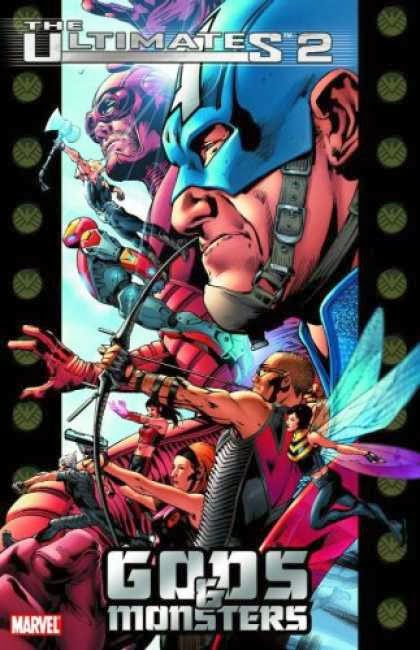
Book: The Ultimates 2 – Vol 1: Gods and Monsters
Pen: Mark Millar
Pencil: Bryan Hitch
The Mighty Thor has his day, and more, in Gods and Monsters. All over The Ultimates, Millar has been teasing us how not everyone was buying the whole ‘Thor is a god from Asgard’ line and people still believed he was just a crackpot with his heart in the right place. It is time to settle that.
The American government, as it usually did, decided to interfere in the affairs of a Middle Eastern country. The supposedly global peace-keeping force – the Ultimates – were sent to sort it out. They did. But Thor dissented and pulled out of the team-up. Before you could say “Ultimates Disassemble” the secret about Hulk is leaked out. The public screams for blood and Fury is only too eager to give them a scapegoat. Despite a blind lawyer, one Matt Murdock, defending him, the jury already made up their minds and it is time for one of the most shattering decisions in comics.
While SHIELD was trying to move into damage control mode they received a call from the European Defense Initiative, the guys who created Captains Britain, France, Spain and Italy! They also meet Gunnar Golmen who was heading the Norwegian group and the secret of Thor comes out. It is time to take the so-called God of Thunder down.
On another note, after his loss of face, Hank Pym is not allowed anywhere near the Ultimates. He goes and joins another superhero team up called the Defenders, which doesn’t exactly end well. But then he learns the truth that is going to be the pivot of the Ultimates 2 storyline. There is a traitor in the ranks.
If you are going to have Thor in the limelight, then you should have his main adversary, too. Loki makes his entrance briefly, but you know he has big plans. Gods and Monsters sets up everything for a grand finale, but that is not to say that it is not capable of standing on its own. With, not one, but two catastrophic events, this is an action-packed edition leaving hardly any time to breathe. At the same time, the constant cut to how the world reacts is how Millar grounds his comic.
The four editions of The Ultimates and The Ultimates 2 can be compared to a relay. Gods and Monsters is the under-appreciated third-leg. As any coach would tell you if your third man is not solid, you would be leaving the impossible for the anchor. Gods and Monsters is solid. The Ultimates are shown at their most vulnerable. An opponent smart enough can dismantle them brutally. And they have such an opponent. Doubts are slowly being raised about the position the Ultimates hold, who they report to and when they should stop. We know a storm is coming. And we can’t wait.
Subscribe to:
Posts (Atom)